Building Islamic Tools as a Developer — Quran, Tasbeeh & Hijri Calendar
I am a web developer. I am also a Muslim. These two parts of my identity come together in the three Islamic tools I have built: a Holy Quran reader, a Digital Tasbeeh counter, and a Hijri Calendar. All three are free. All three are ad-free. And all three will stay that way forever. This is the story of why I build Islamic tools, the philosophy behind them, and the technical decisions that shape how I approach sacred content.
The Sadqa Jariya Principle
Everything I build for the Muslim community operates under one guiding principle: Sadqa Jariya, which means ongoing charity. The Prophet Muhammad, peace be upon him, said that when a person dies, their deeds end except for three things, one of which is Sadqa Jariya. I built these tools hoping they would be exactly that: a source of ongoing benefit that continues as long as people use them.
In practice, this means every Islamic tool I build follows non-negotiable rules. It must be 100% free forever. It must be 100% ad-free forever. No paywalls, no premium tiers, no donations asked, no accounts required. You cannot earn money from the Word of Allah. This is not a business strategy. It is a personal conviction rooted in my faith.
Each tool includes a "Share with the Ummah" section with the hadith: "Whoever guides someone to goodness will have a reward like the one who did it" from Sahih Muslim 1893. This is not a growth hack. It is a genuine invitation to share something beneficial so that both the sharer and the developer earn ongoing reward.
The Holy Quran Reader
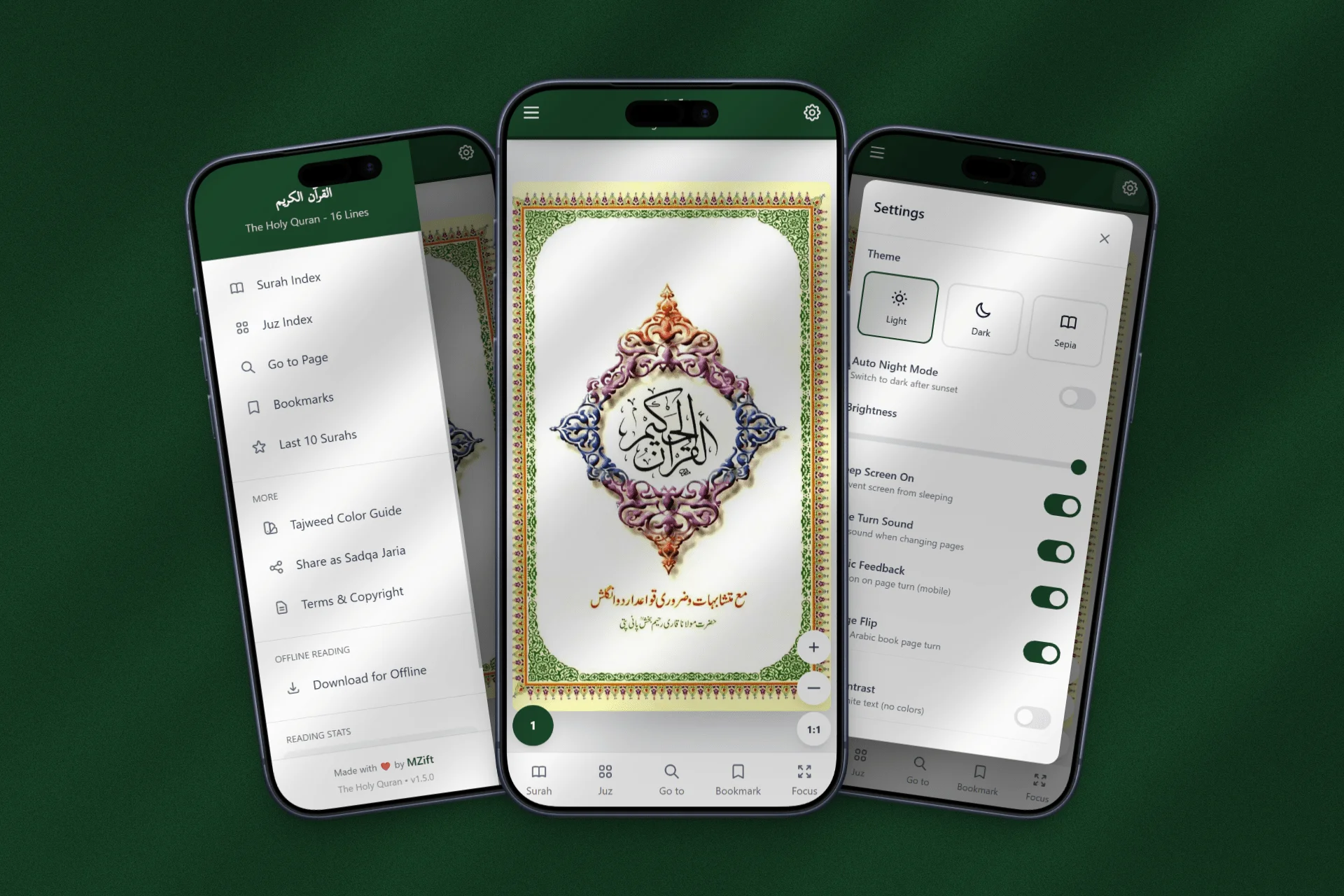
The Quran reader was the first Islamic tool I built, and it remains the most impactful. It displays the complete Quran using authentic page images sourced from GuidancetoQuran.com in a 16-line Mushaf layout with color-coded Tajweed rules. I chose to render page images rather than Arabic text for a critical reason: accuracy. When dealing with the Word of Allah, there is zero margin for error. Professionally produced Mushaf images with verified Tajweed coloring are more reliable than trying to render Arabic text programmatically.
The reader is a Progressive Web App at version 1.5.0. It works offline after the first visit, has a 3D page flip animation, touch and swipe gestures, bookmarks with reading progress, Surah and Juz navigation, and multiple themes including auto night mode. It supports iOS, Android, Windows, Mac, and Linux. It reached over 1,500 visitors within three months through organic search and word-of-mouth sharing.
I released it under a Sadqa Jariya License: you can share it freely, but you cannot sell it, add ads, ask for donations, or modify the source code. The Word of Allah must remain accessible to everyone without barriers.
The Digital Tasbeeh
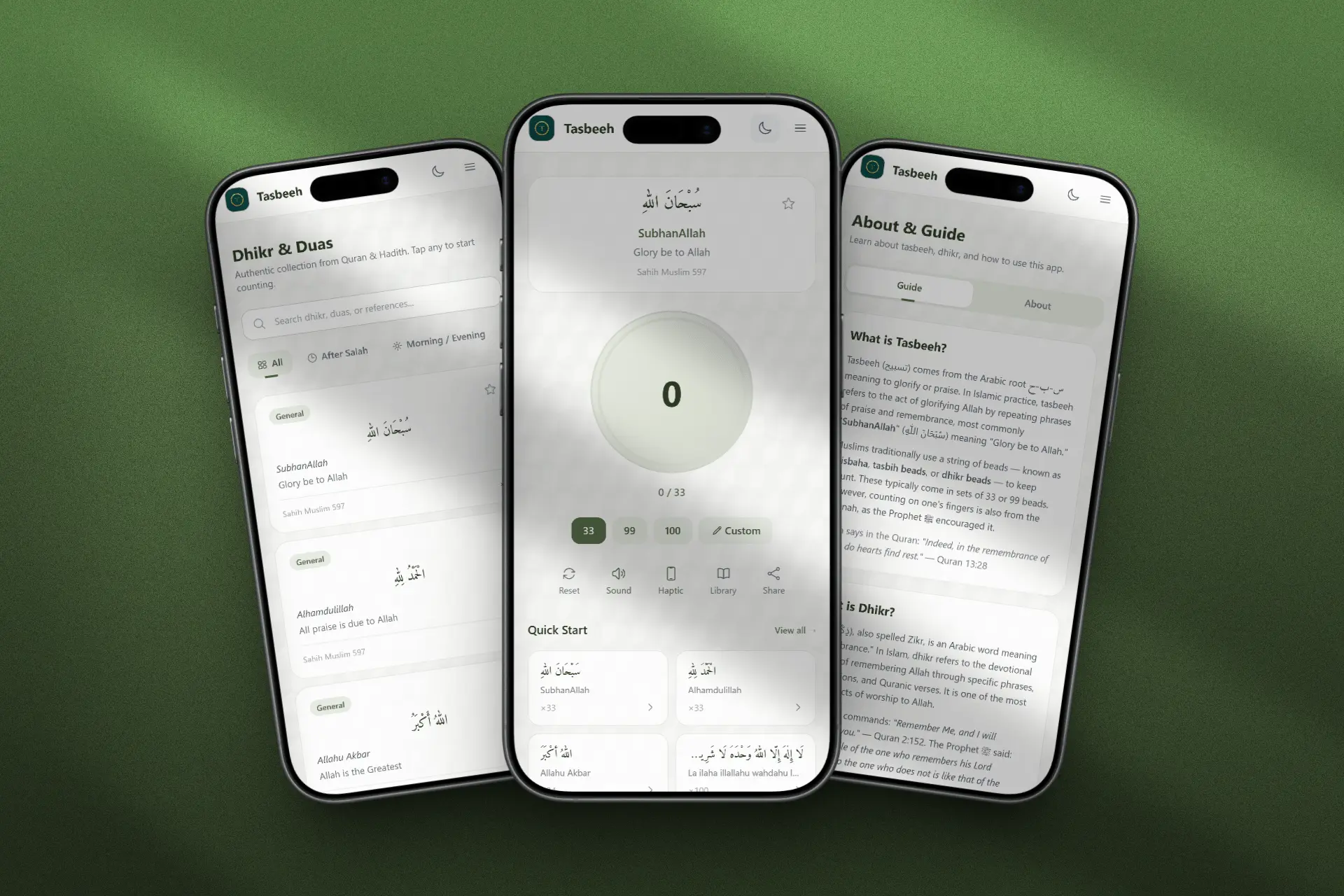
The Tasbeeh counter grew directly out of the Quran reader community. Users who came for Quran reading were also looking for a clean dhikr counter, and the existing options were disappointing. Most tasbeeh apps track your data, show ads during worship, or require permissions that have no business being in a prayer tool.
I built a clean counter with a library of authentic duas and dhikr sourced from the Quran and five major hadith collections: Bukhari, Muslim, Abu Dawud, Tirmidhi, and Nasa'i. Every phrase includes Arabic text, transliteration, English translation, and the specific hadith reference so users can verify the authenticity themselves. The counter supports presets of 33, 99, and 100, plus custom counts, with optional sound and haptic feedback.
The quick start section provides the most common post-salah dhikr immediately: SubhanAllah 33 times, Alhamdulillah 33 times, Allahu Akbar 34 times, and the full La ilaha illallah declaration 100 times. Like the Quran reader, it works offline, requires no account, and tracks nothing. Your worship is between you and Allah.
The Hijri Calendar
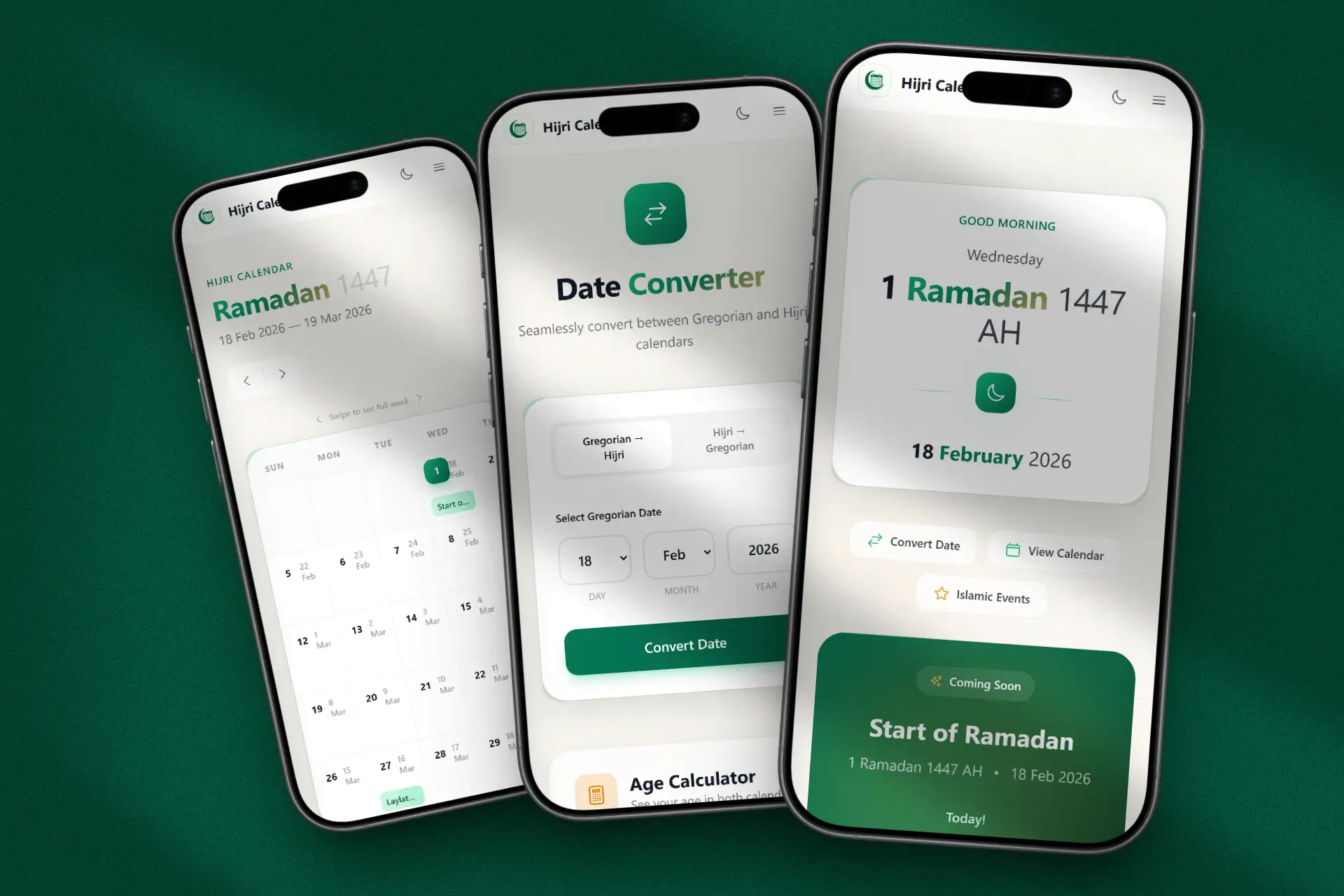
Muslims worldwide need accurate Hijri dates for worship, planning, and daily life. But most online Islamic calendars are cluttered with ads, have poor user experience, or provide inaccurate date conversions. I built the MZift Hijri Calendar as a clean, fast alternative.
The calendar uses the Umm al-Qura calendar system for accuracy and displays Hijri and Gregorian dates side by side. It includes live countdowns showing days, hours, minutes, and seconds until upcoming events like the Day of Arafah, Eid al-Adha, Eid al-Fitr, and Islamic New Year. A bidirectional date converter handles instant Hijri-to-Gregorian and Gregorian-to-Hijri conversions. A comprehensive months section provides historical and religious context for each Hijri month.
I include a clear disclaimer that actual dates may differ by one to two days based on local moon sighting and recommend confirming important dates with your local mosque or Islamic authority. The calendar also includes calendar export for adding Islamic dates to your favorite calendar app. It attracted over 300 visitors in its first week.
Design Decisions for Sacred Content
Building Islamic tools requires a different mindset than building typical web apps. Every design decision must respect the context. Here are the principles I follow.
No distractions during worship. A Quran reader is not a social media app. A tasbeeh counter is not a game. The interface should fade into the background and let the user focus on what matters: their connection with Allah. This means no banners, no notifications, no social features, and no gamification of worship.
Accuracy is non-negotiable. When dealing with the Quran, hadith references, or prayer formulas, a typo is not harmless. I use authenticated sources for all content: GuidancetoQuran.com for Quran pages, and verified hadith collections for dhikr text. I take error reports extremely seriously and fix them immediately.
Offline first. Muslims read the Quran and make dhikr in places without reliable internet: at the masjid, during Taraweeh prayers, while traveling. If your Islamic app breaks without WiFi, you have failed your users. All three tools work completely offline after the first visit.
Privacy as a right. I do not track what Surah someone is reading, what dhikr they are counting, or when they are praying. That information is sacred and personal. The tools use no analytics tracking of user worship activity. Your data stays on your device.
The Ecosystem Effect
The three Islamic tools work as an ecosystem. The Quran reader links to the Tasbeeh for post-reading dhikr. The Tasbeeh links to the Quran reader and Hijri Calendar. The Hijri Calendar links back to both. Each tool cross-promotes the others, creating a natural flow between different aspects of Islamic practice.
This interconnection also helps with growth. A user who discovers the Quran reader through search may then discover the Tasbeeh and Calendar through internal links. Each tool becomes a gateway to the others. Combined, the three tools serve a growing community of Muslim users who appreciate clean, respectful, and genuinely useful Islamic technology.
What I Have Learned
Building Islamic tools has changed how I think about software development. When your motivation is Sadqa Jariya rather than revenue, every decision becomes clearer. You do not add ads because they would disrupt worship. You do not add paywalls because access to Islamic content should be universal. You do not track users because their worship is private.
The response from the Muslim community has been humbling. Users share the tools with family and friends, leave kind messages, and report errors with genuine care for accuracy. Building for a community that shares your values creates a feedback loop of trust and improvement that no marketing budget can replicate.
If you are a developer who is also a person of faith, consider building tools for your community. The technical skills you use every day at work can become a source of ongoing benefit for others. Start small, ship fast, and let the community tell you what they need. May Allah accept these efforts as Sadqa Jariya. Ameen.